
- Priced
- Per implant, by implant system
- Systems on our list
- Turkish, German, Swedish premium
- Listed separately in a plan
- Abutment, crown, any graft or sinus lift
- Healing before final teeth
- Usually 3–6 months, unless immediate loading suits you
- Trips to Istanbul
- Usually two
- Exact cost
- Written plan after examination and X-rays or a scan
Dental implants Turkey cost per implant, by system
The price of the implant itself depends mainly on which implant system is used. Our list has three lines, and the range within each line reflects the size and type of implant and the complexity of placement.
| Treatment | Price range (TRY) | Approx. GBP | Approx. EUR | Approx. USD |
|---|---|---|---|---|
| Implant, Turkish system (per implant) | 7,000–9,000 | £105–£135 | €125–€160 | $140–$180 |
| Implant, German system (per implant) | 14,000–16,000 | £210–£240 | €250–€290 | $280–$320 |
| Implant, Swedish premium system (per implant) | 28,000–35,000 | £420–£530 | €500–€630 | $560–$700 |
| Zirconia crown (per tooth) | 5,000–7,000 | £75–£105 | €90–€125 | $100–$140 |
| E.max all-ceramic crown (per tooth) | 8,000–12,000 | £120–£180 | €145–€220 | $160–$240 |
Please note: these ranges come from our clinic price list and are shared to help you plan a budget. They are information, not a quote or an offer. The exact cost can only be set after an examination, any X-rays or scans needed, and a written treatment plan. Our list is in Turkish lira; amounts in pounds, euros and dollars are approximate, converted at the European Central Bank rate of 23 October 2026, and change with the exchange rate.
The crown lines are included because almost every implant ends up carrying a crown or a bridge, and that part is priced as its own line. For the treatment itself, how it is done and how long it takes, see our main page on dental implants in Turkey.
Turkish, German or Swedish system: what the price difference reflects
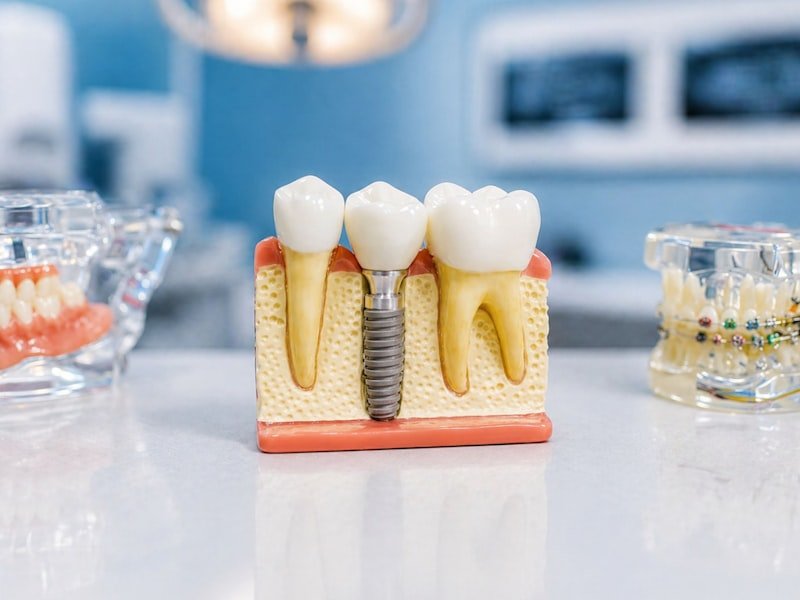
All three systems on our list are titanium implants that work on the same principle: a screw-shaped post that fuses with the jawbone and later holds a tooth. The price difference is mostly about the manufacturer, the range of components available, and how widely the system is used around the world.
Points that are worth weighing beyond price:
- Parts at home. If a screw loosens or a crown needs replacing years later, your dentist at home needs compatible parts. Systems used widely in your country make that easier. Your written plan should name the system so your own dentist can check.
- Clinical situation. Some systems offer shapes and sizes that suit narrow ridges, soft bone or immediate placement better. Your surgeon may recommend a particular system for that reason.
- Number of implants. The gap between systems multiplies with every implant. For one tooth it is modest; for a full mouth it becomes a large part of the total.
We do not suggest that one system is right for everybody. Ask the dentist why a system is recommended for you, and ask for the answer in the plan.
What else an implant plan may include
An implant plan is rarely just the implant. A complete written plan lists every part needed to go from a gap to a working tooth, and the total depends on how many of these you need:
- Abutment. The connector that sits on the implant and holds the crown. The plan should say which abutment is used and show it as a line.
- Crown or bridge. The visible tooth, usually zirconia or E.max for a single tooth. Several implants may carry a bridge instead of individual crowns.
- Extraction. If the failing tooth is still in place, it is removed first, sometimes on the same day as the implant.
- Bone graft. Needed when the bone is too thin or too low to hold an implant. See bone grafts in Turkey.
- Sinus lift. In the upper back jaw, where the sinus sits close to the bone, the sinus floor may need raising. See sinus lifts in Turkey.
- Temporary teeth. Something to wear during healing, especially for front teeth.
Abutments, grafts, sinus lifts and temporaries are not on our printed list because they vary too much between patients. Their cost is set in the written plan after assessment, and you should see every one of them before agreeing to treatment.
Examples: one tooth and a short gap
The examples below are arithmetic only, built by adding our listed ranges. They are here to show how a total is put together, not to price your treatment. They leave out the abutment and anything else your plan may need, such as an extraction or graft.
| Treatment | Price range (TRY) | Approx. GBP | Approx. EUR | Approx. USD |
|---|---|---|---|---|
| Example: 1 Turkish-system implant + 1 zirconia crown | 12,000–16,000 | £180–£240 | €215–€285 | $240–$320 |
| Example: 1 German-system implant + 1 zirconia crown | 19,000–23,000 | £285–£345 | €340–€415 | $380–$460 |
| Example: 1 Swedish premium implant + 1 E.max crown | 36,000–47,000 | £540–£710 | €645–€850 | $720–$940 |
| Example: 2 German-system implants carrying 3 zirconia crown units | 43,000–53,000 | £645–£795 | €770–€955 | $860–$1,060 |
Please note: these ranges come from our clinic price list and are shared to help you plan a budget. They are information, not a quote or an offer. The exact cost can only be set after an examination, any X-rays or scans needed, and a written treatment plan. Our list is in Turkish lira; amounts in pounds, euros and dollars are approximate, converted at the European Central Bank rate of 23 October 2026, and change with the exchange rate.
The last line shows why a bridge on implants is often planned for a gap of three teeth: two implants can carry three teeth, so you pay for two implants rather than three. Whether that works depends on bone, bite and where the gap is. Our article on implants vs bridges compares the options.
Full mouth dental implants: a worked example
A full-mouth implant total is mainly the number of implants multiplied by the implant price, plus the teeth they carry. The example below is arithmetic only and is labelled as such. It is not a price for an All-on-4 or All-on-6 bridge, which is not on our list and is priced only in a written plan.
Example only: six implants in each jaw (twelve in total), carrying twenty-four zirconia crown units. Abutments, extractions, temporary teeth and any grafts or sinus lifts are not included.
| Treatment | Price range (TRY) | Approx. GBP | Approx. EUR | Approx. USD |
|---|---|---|---|---|
| Example: 12 Turkish-system implants | 84,000–108,000 | £1,260–£1,620 | €1,500–€1,920 | $1,680–$2,160 |
| Example: 12 German-system implants | 168,000–192,000 | £2,520–£2,880 | €3,000–€3,480 | $3,360–$3,840 |
| Example: 12 Swedish premium implants | 336,000–420,000 | £5,040–£6,360 | €6,000–€7,560 | $6,720–$8,400 |
| Example: 24 zirconia crown units | 120,000–168,000 | £1,800–£2,520 | €2,160–€3,000 | $2,400–$3,360 |
| Example total with Turkish system | 204,000–276,000 | £3,060–£4,140 | €3,660–€4,920 | $4,080–$5,520 |
| Example total with German system | 288,000–360,000 | £4,320–£5,400 | €5,160–€6,480 | $5,760–$7,200 |
| Example total with Swedish premium system | 456,000–588,000 | £6,840–£8,880 | €8,160–€10,560 | $9,120–$11,760 |
Please note: these ranges come from our clinic price list and are shared to help you plan a budget. They are information, not a quote or an offer. The exact cost can only be set after an examination, any X-rays or scans needed, and a written treatment plan. Our list is in Turkish lira; amounts in pounds, euros and dollars are approximate, converted at the European Central Bank rate of 23 October 2026, and change with the exchange rate.
Real full-mouth plans vary a great deal. Some people keep healthy teeth and need implants only in parts of the mouth; others need fewer implants per jaw with a fixed bridge, or more where bone is soft. See full mouth dental implants in Turkey for how these plans are designed.
Why implant costs often rise after the examination
The most common reason an implant estimate changes is bone. Photos cannot show bone at all, and a standard X-ray shows only height, not width. A 3D scan (CBCT) at the examination shows whether there is enough bone in every direction, and how close the implant would be to a nerve or the sinus.
Other reasons a plan can change:
- An infection around the tooth to be removed, which may mean extracting first and placing the implant after healing.
- Gum disease elsewhere in the mouth, which should be treated before implants are placed, because it raises the risk of problems around implants too.
- A different implant size or system becoming more suitable once the bone is measured.
- Neighbouring teeth that need treatment so the new crown has a sound bite to work against.
Sending a recent panoramic X-ray or scan from home with your photos narrows the gap between the preliminary plan and the final one.
Two trips: how timing affects your budget
Most implant treatment is done over two trips, because the implant usually needs about 3–6 months to fuse with the bone before the final crown or bridge is fitted. On the first trip the implants are placed; on the second the final teeth are made and fitted. Each trip is usually about a week, though your plan states the exact number of days.
Immediate loading, where teeth are fixed onto implants within days, is possible only when bone density and gum conditions allow, and your dentist decides this after examination and a scan. See same-day implants in Turkey. If it is not suitable for you, rushing it raises the risk of the implant failing to integrate.
When budgeting, count two sets of flights and accommodation. We can help arrange an airport transfer and accommodation on both trips.
Who is not a good fit for implants, whatever the price
Implants are not suitable for everyone, and a lower price does not change that. Heavy smoking, poorly controlled diabetes, untreated gum disease, some medicines that affect bone (such as certain osteoporosis drugs), and radiotherapy to the jaw all raise the risk of complications and may rule implants out or delay them.
Possible complications include infection, the implant failing to fuse with the bone, nerve irritation in the lower jaw causing numbness, sinus problems in the upper jaw, and, over the years, inflammation around the implant if cleaning is poor. Your surgeon should discuss these with you before any plan is signed. Implant surgery at our clinic is carried out by Dt. Yusuf Yuca, PhD, Dt. Cemal Özdemir and Dt. Kadri Söylemez.
Frequently asked questions
How much does one dental implant cost in Turkey?
Does the implant price include the crown?
How much do full mouth dental implants cost in Turkey?
Why is the Swedish premium implant so much more expensive?
How much is a bone graft or sinus lift in Turkey?
Will I need two trips to Turkey for implants?
Can I get an implant price from photos?
This page gives general information and is not a substitute for an examination. Whether a treatment is suitable for you, and how long it takes, is decided after your dentist has examined you and reviewed your X-rays.