
- Options
- Individual implants, All-on-4, All-on-6, implant-retained denture
- Trips to Istanbul
- Usually two; three if staged grafting is needed
- Length of each trip
- Often about 5–7 days
- Healing between trips
- Typically 3–6 months
- Anaesthesia
- Local anaesthetic
- Planning
- X-rays, usually a 3D scan, and a written plan
What does “full mouth dental implants” mean?
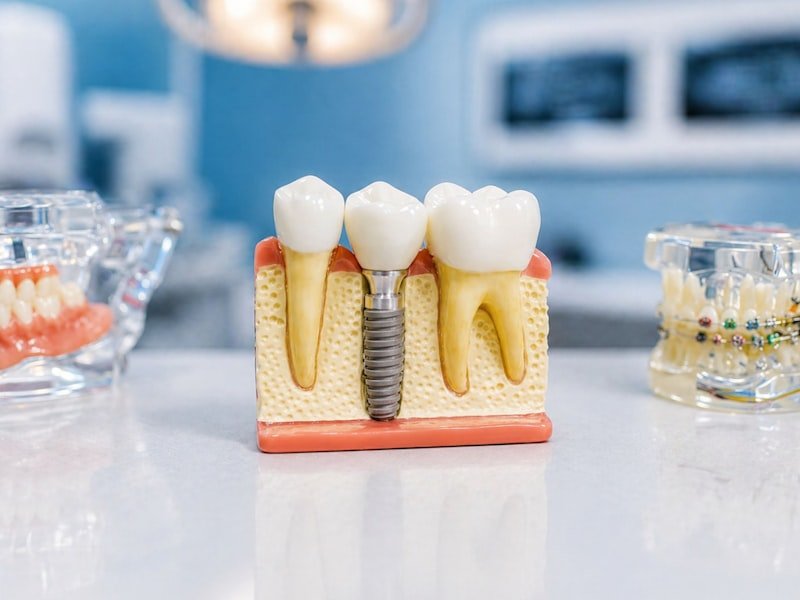
Full mouth dental implants is a broad term rather than one procedure. It describes any plan that replaces all, or nearly all, of the teeth in the upper jaw, the lower jaw or both, using implants as the support. The implants are titanium posts placed in the jawbone; the teeth attached to them can be fixed in place or removable.
People usually arrive at this point in one of three ways: they have already lost most of their teeth and wear dentures, their remaining teeth are badly affected by gum disease or decay, or earlier dental work has failed across the mouth. Each situation leads to a different plan. Sometimes a few healthy teeth can be kept, which changes the design again.
For the basics of how a single implant works and heals, see dental implants in Turkey. This page compares the ways of replacing a whole mouth.
Four ways to replace all your teeth with implants
There are four main approaches. Each can be used in one jaw or both, and the upper and lower jaws do not have to use the same one.
1. Individual implants with crowns and bridges
Commonly six to eight implants per jaw carry a series of separate crowns and shorter bridges. It most closely resembles natural teeth and allows flossing between sections, but it needs good bone along the whole jaw and more surgery.
2. All-on-4
A single fixed bridge on four implants, with the back two tilted to make use of the bone available at the front of the jaw. It can avoid grafting in many people with bone loss. See All-on-4 in Turkey.
3. All-on-6
The same fixed bridge idea on six implants, spreading the load more widely; it suits softer upper bone or a strong bite where bone allows. See All-on-6 in Turkey.
4. Implant-retained denture
A removable denture that clips onto two to four implants, often used in the lower jaw. It is far more stable than a loose denture, needs fewer implants and is taken out for cleaning. More on this is on our dentures page.
Full mouth implants, step by step
- Before you travel: preliminary plan: Send photos and any X-rays on WhatsApp. A dentist replies with the likely option, the number of trips and the expected number of days.
- Trip 1: examination and imaging: Examination, X-rays and usually a 3D scan, a review of your medical history and the written treatment plan with the total cost.
- Trip 1: extractions and implants: Teeth that cannot be saved are removed and implants placed under local anaesthetic, one or both jaws.
- Trip 1: temporary teeth: Fixed temporary teeth where the implants are stable enough, otherwise a temporary denture. Check-up before you fly.
- At home: healing: Typically three to six months, longer after grafting. Soft diet first; we stay in touch on WhatsApp.
- Trip 2: final teeth: Scans or impressions, a try-in of shape and shade, then fitting of the final crowns, bridges or denture and bite adjustment.
Comparing the full mouth options
| Individual implants + crowns/bridges | All-on-4 / All-on-6 | Implant-retained denture | |
|---|---|---|---|
| Implants per jaw | Often 6–8 | 4 or 6 | Often 2–4 |
| Fixed or removable | Fixed | Fixed (only a dentist removes it) | Removable by you |
| Bone needed | Along most of the jaw | Less, especially with All-on-4 | Least |
| Grafting likely? | More often | Less often | Rarely |
| Cleaning | Similar to natural teeth, between sections | Under one bridge with a water flosser | Denture out daily; clean the clips and implants |
| If one part breaks | Only that section is affected | The whole bridge comes out for repair | Clips and denture can be renewed |
No option is right for everyone. A healthy person with good bone who wants teeth that feel separate may prefer individual implants; someone with significant bone loss who wants fixed teeth may be better served by All-on-4; someone who wants fewer implants or less surgery may prefer an implant-retained denture.
How many trips to Turkey for full mouth implants?
Most full mouth implant plans need two trips to Istanbul. The first is for examination, extractions and implant placement, and usually lasts about five to seven days. The second, three to six months later, is for the final teeth and is of similar length.
A third trip is sometimes needed. The most common reason is a large bone graft or a sinus lift that must heal before implants can go in. Another is a plan where extractions and implants are done in stages because of infection or because many teeth are involved. Your preliminary plan will tell you whether this looks likely, so you can book flights knowing the full picture.
Because surgery should happen early in each stay, we suggest arriving with a day or two to spare at the end. Our guide on how long to stay in Turkey for dental work explains the planning in more detail.
A realistic full mouth implant timeline
From the first message to the final teeth, a typical full mouth plan takes four to seven months. A plan with staged grafting can take nine months to a year.
- Weeks before travel: you send photos and X-rays on WhatsApp; a dentist replies with a preliminary plan and the expected number of days.
- Trip 1: examination, imaging, extractions, implants and temporary teeth.
- Months 1–3: healing at home, soft food at first, then gradually firmer.
- Months 3–6: the implants complete their bond with the bone; the lower jaw is often ready sooner than the upper.
- Trip 2: scans or impressions, a try-in of the new teeth, then fitting and bite adjustment.
Anyone told that a full mouth of final implant teeth can be completed in a single short visit should ask what is being skipped. Fixed temporary teeth soon after surgery are possible in suitable cases, but the final teeth are made after healing.
Do you have to remove all your teeth?
Not always. Healthy teeth with good bone support can often be kept and included in the plan, and keeping them preserves bone and sensation. Teeth with advanced gum disease, deep decay or cracks below the gum, however, can compromise the implants next to them if they are kept, and a full-arch plan is sometimes the more predictable route.
The decision is made tooth by tooth after X-rays and an examination, not from a photo alone. If you are unsure whether your teeth can be saved, ask the dentist to explain the reason for each extraction in the plan. Gum treatment beforehand is part of some plans; see gum disease treatment.
Full mouth dental implants Turkey cost: per-implant ranges
We do not publish a total for a full mouth or a full arch, because the total depends on how many implants are needed, which option you choose, the crown or bridge material, extractions, grafting and temporary teeth. What we can share is the per-implant range from our clinic price list.
| Treatment | Price range (TRY) | Approx. GBP | Approx. EUR | Approx. USD |
|---|---|---|---|---|
| Implant, Turkish system (per implant) | 7,000–9,000 | £105–£135 | €125–€160 | $140–$180 |
| Implant, German system (per implant) | 14,000–16,000 | £210–£240 | €250–€290 | $280–$320 |
| Implant, Swedish premium system (per implant) | 28,000–35,000 | £420–£530 | €500–€630 | $560–$700 |
Please note: these ranges come from our clinic price list and are shared to help you plan a budget. They are information, not a quote or an offer. The exact cost can only be set after an examination, any X-rays or scans needed, and a written treatment plan. Our list is in Turkish lira; amounts in pounds, euros and dollars are approximate, converted at the European Central Bank rate of 23 October 2026, and change with the exchange rate.
These are per implant, as in our price list. The written plan lists every part needed for your case: implants, abutments, crowns or bridge, and any graft or sinus lift. Compare written plans rather than headline figures; more detail is on dental implants Turkey cost.
Who should not rush into full mouth implants
Full mouth treatment is a large surgical and financial commitment, and some people are better served by waiting or by another approach. These need discussing first:
- Smoking, which raises the risk of implant failure and slows healing.
- Diabetes that is not well controlled; bring a recent blood test result.
- Bone medicines such as bisphosphonates, now or in the past, and any radiotherapy to the head or neck.
- Heavy grinding, which puts strain on fixed bridges and usually means a night guard.
- Limited ability to clean, for example because of arthritis in the hands; a removable option may then be easier to look after.
Possible complications include swelling, bruising, infection, an implant that does not bond, temporary numbness and, over the years, gum inflammation around implants. Implant surgery at our clinic is carried out by Dt. Yusuf Yuca, PhD and Dt. Cemal Özdemir, who work in oral surgery and implants.
Frequently asked questions
How many implants do you need for a full mouth?
How many trips to Turkey are needed for full mouth implants?
How long does full mouth implant treatment take from start to finish?
How much do full mouth dental implants cost in Turkey?
Are fixed implant teeth better than an implant-retained denture?
Will I be without teeth during full mouth implant treatment?
Can full mouth implants be done if I have bone loss?
This page gives general information and is not a substitute for an examination. Whether a treatment is suitable for you, and how long it takes, is decided after your dentist has examined you and reviewed your X-rays.