
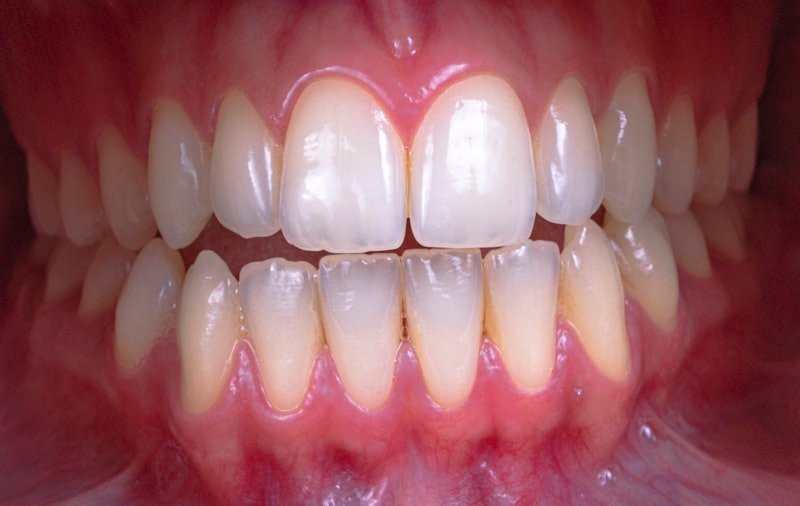
- Main treatment
- Scaling and root planing (deep cleaning)
- Anaesthesia
- Local anaesthetic where needed
- Sessions
- Often 1–4, depending on severity
- Review
- Gums rechecked after healing
- Maintenance
- Cleaning every 3–6 months
- First visit
- Free examination and X-rays
Gingivitis vs periodontitis: what is the difference?
Gum disease is a bacterial infection of the tissues that hold the teeth in place, and it comes in two stages. Gingivitis is inflammation of the gum only: it looks red, swells and bleeds when you brush, but the bone is untouched and the damage is fully reversible with good cleaning. Periodontitis is the later stage, where the inflammation has spread below the gumline, the gum has started to separate from the tooth to form pockets, and bone has been lost. Bone lost to periodontitis does not grow back on its own; treatment aims to stop the disease and keep what remains.
| Gingivitis | Periodontitis | |
|---|---|---|
| What is affected | Gum tissue only | Gum, ligament and supporting bone |
| Typical signs | Bleeding, redness, swelling | Pockets, recession, bad breath, loose or drifting teeth |
| Reversible? | Yes | Can be stabilised; lost bone usually does not return |
| Usual treatment | Professional clean and better home care | Deep cleaning, sometimes surgery, then lifelong maintenance |
Why gums must be healthy before crowns, veneers or implants
This is the part of dental work in Turkey that is too often skipped. When veneers or crowns are fitted onto inflamed gums, the swollen tissue later shrinks back as it heals, leaving dark margins and gaps at the edges. Bleeding gums also make it hard to take an accurate scan and to bond restorations properly. With implants the stakes are higher still: the same bacteria that cause periodontitis can attack the bone around an implant, a condition called peri-implantitis, which is a leading cause of implant failure.
Many of the problems people describe as Turkey teeth include gum issues as well as over-prepared teeth: puffy gums around crowns, black lines at the margins and bleeding that never settles. Treating gum disease first adds time to a plan, sometimes a few weeks, but it protects everything that follows. If you are planning dental implants or a smile makeover, expect us to check your gums before anything else.
Gum treatment, step by step
- Examination: Free check-up with X-rays to see bone levels, plus pocket measurements around each tooth.
- Diagnosis and plan: The dentist explains whether you have gingivitis or periodontitis, how advanced it is, and how this affects any cosmetic plans.
- Professional clean or deep clean: A scale and polish for gingivitis, or scaling and root planing under local anaesthetic for periodontitis.
- Home care: You are shown how to brush and clean between your teeth in a way that suits your gums.
- Re-evaluation: Pockets are measured again after healing to decide whether further treatment or surgery is needed.
- Next steps: Cosmetic or implant work goes ahead once gums are stable, followed by regular maintenance.
Signs of gum disease to look out for
Gum disease is often painless until it is advanced, which is why many people only find out at a check-up. Common warning signs include:
- Gums that bleed when you brush or floss
- Red, puffy or tender gums
- Persistent bad breath or a bad taste
- Gums pulling back so that teeth look longer
- New gaps appearing between teeth, or front teeth fanning out
- Teeth that feel loose or bite differently
Bleeding is not normal, even if it happens every day. If you notice any of these and are planning cosmetic work in Istanbul, mention them when you send us your photos.
Deep cleaning: scaling and root planing
The main treatment for periodontitis is scaling and root planing, often called a deep clean. It goes further than a routine scale and polish: the dentist removes hardened tartar and bacterial film from the root surfaces inside the pockets, then smooths those surfaces so the gum can reattach more closely.
Because the work is below the gumline, it is usually done under local anaesthetic, one or two quarters of the mouth at a time, or the whole mouth over consecutive sessions. Gums are often sore and teeth sensitive to cold for a few days. As the inflammation settles, gums tighten and may recede slightly, so teeth can look a little longer.
Healing is then checked, ideally several weeks later, by measuring the pockets again. For patients travelling to Istanbul, we plan this around your trip: deep cleaning early in the stay, cosmetic work only once the gums allow, and in more advanced cases a separate visit for the cosmetic stage. In some cases antibiotics are used alongside cleaning, but they are not a substitute for it.
Gum recession treatment and gum grafts
Gum recession is when the gum margin pulls back and exposes the root of a tooth. Causes include periodontitis, aggressive brushing, thin gum tissue, teeth that sit too far forward and, in some people, clenching. Exposed roots can be sensitive, are more prone to decay and can look uneven in a smile.
Treatment depends on the cause and severity. Mild recession may need only a change in brushing technique, a desensitising treatment or a tooth-coloured filling over the exposed root. Where more cover is needed, a gum graft may be suggested. The most common technique takes a thin piece of tissue from the palate and places it over the exposed root; other approaches reposition nearby gum or use a substitute graft material. The so-called pinhole technique repositions gum through small openings rather than incisions. Not every case is suitable for root coverage, and results are best on single teeth with good bone between them.
Graft surgery is carried out under local anaesthetic. Healing usually takes around two weeks for the surface, with final maturing over a few months, and stitches may need removing. That needs to be factored into any travel plan.
Laser gum treatment: what it can and cannot do
Lasers are used in gum treatment in some practices, mainly to remove inflamed tissue lining the pockets, to reduce bacteria and to reshape gum tissue with less bleeding. They can be a useful additional tool, and some patients find them more comfortable for certain procedures.
The evidence, though, does not show that lasers on their own outperform thorough mechanical deep cleaning for periodontitis. They do not remove hardened tartar from roots as effectively as hand and ultrasonic instruments, and they do not regrow bone. If you see laser gum treatment in Turkey promoted as a quick cure, treat that with caution. The dentist will explain the methods available at our clinic and which ones are appropriate for your gums.
Smoking, diabetes and other risk factors
Some people are far more prone to gum disease, and these factors also affect how well treatment works:
- Smoking and vaping reduce blood flow to the gums, hide bleeding and slow healing. Smokers respond less well to treatment and have a higher risk of implant problems.
- Diabetes, especially when poorly controlled, increases the risk and severity of periodontitis, and untreated gum disease can make blood sugar harder to control.
- Pregnancy often causes temporary gum inflammation.
- Some medicines, including certain blood pressure and anti-seizure drugs, can cause gum overgrowth or a dry mouth.
- Family history and stress also play a part.
Please tell us about health conditions and medicines before your visit. It helps us plan safely and set realistic expectations.
Keeping gums healthy after treatment
Periodontitis can be controlled but not cured once and for all, so maintenance is part of the treatment. That means careful daily brushing, cleaning between teeth with interdental brushes, and professional cleaning every three to six months with a dentist or hygienist near home. If you have been treated in Istanbul, take your notes and pocket measurements home so your local dentist can continue from where we left off. For questions after you return, our team is on WhatsApp.
Frequently asked questions
Can I have gum disease treatment in Turkey?
Do I need gum treatment before veneers or crowns?
Is a deep clean painful?
Can receding gums grow back?
Is laser gum treatment better than a deep clean?
What does the cost of gum treatment in Turkey depend on?
Is gum disease linked to other health problems?
This page gives general information and is not a substitute for an examination. Whether a treatment is suitable for you, and how long it takes, is decided after your dentist has examined you and reviewed your X-rays.