
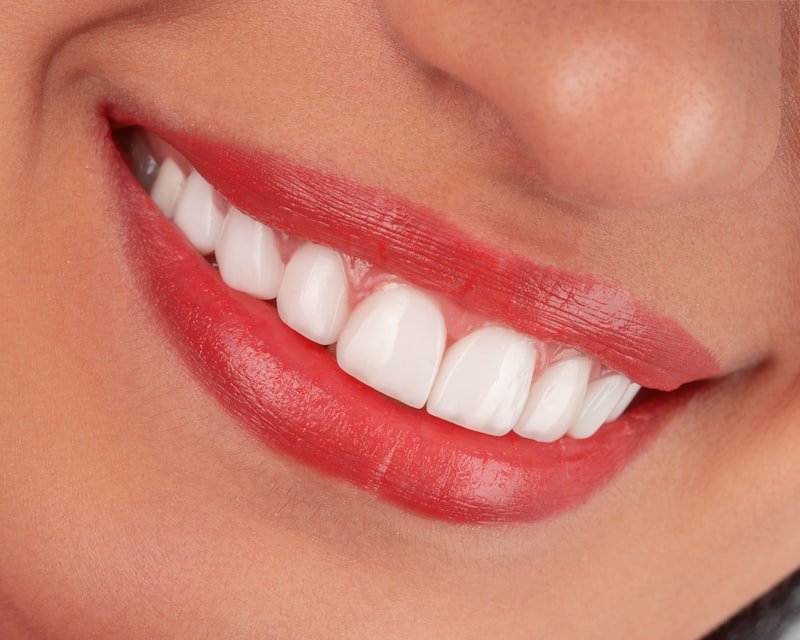
- Time in Istanbul
- Usually 5–7 days
- Visits
- About 3–4 appointments
- Tooth preparation
- Minimal, enamel only; sometimes none
- Material
- E.max (lithium disilicate) or feldspathic porcelain
- Anaesthesia
- Local anaesthetic, if preparation is needed
- Typical lifespan
- 10–15 years or more with good care
What are veneers, and how are they different from “Turkey teeth”?
A veneer covers only the visible front surface of a tooth, plus a little of the biting edge. A porcelain veneer is typically between 0.3 and 0.7 mm thick, so the tooth underneath needs very little reshaping, and in some cases none at all. The back and sides of the tooth stay exactly as they are.
The phrase “Turkey teeth” usually describes something else. In many of the cases that have made the news, healthy teeth were filed down into small stumps all the way round and covered with full crowns, often a whole arch at a time. That is not a veneer treatment, even when it is sold under that name. A crown removes far more tooth, can irritate the nerve, and commits you to replacing that crown for the rest of your life.
Our starting point is the opposite. If your teeth are healthy and the problem is colour, small chips, gaps or uneven edges, we look first at whitening, bonding or veneers, and only suggest crowns where a tooth is already badly broken or heavily filled. If you want the background, our article on what Turkey teeth really are explains it in more detail.
Is Turkey good for veneers?
Turkey can be a good place for veneers when the clinic plans conservatively, shows you the result before preparing any tooth, and gives you a written plan you can check with a dentist at home. Many patients travel because treatment costs less than in the UK, Ireland or the US, but the price should never be the deciding factor on its own.
Questions worth asking any clinic, including ours:
- Will you see my X-rays and examine my gums before deciding on veneers?
- How much enamel will be removed, and will any tooth be prepared for a crown?
- Will I see a mock-up of the new shape on my own teeth first?
- Which dentist will do the work, and can I speak to them in English?
- What happens if a veneer chips or comes loose after I fly home?
A clinic that answers these openly is usually one that plans carefully. The same questions apply whichever clinic you choose.
Veneers in Istanbul, step by step
- Before you travel: photos and plan: Send smile photos and any recent X-rays on WhatsApp. A dentist reviews them and replies with a preliminary plan and the expected number of days.
- Day 1: examination and design: Free examination and X-ray, gum check, shade selection and photos. The new tooth shape is designed and discussed with you.
- Day 2: mock-up and preparation: A trial smile in temporary material is placed over your teeth so you can see and approve it. Teeth are then lightly prepared, scanned or impressed, and covered with temporaries.
- Days 3–5: laboratory: The dental technician makes the veneers to the approved design. You are free to rest and see Istanbul.
- Day 5 or 6: try-in: Veneers are tried in before bonding so that fit, shape and colour can be checked and changed if needed.
- Day 6 or 7: bonding and final check: Veneers are bonded, the bite is adjusted, and a night guard is made if you grind. You receive aftercare advice before you fly.
E.max veneers in Turkey: which porcelain is used?
Most veneers we plan are made from E.max, a lithium disilicate glass-ceramic. It is strong for its thickness, bonds very well to enamel and lets light pass through in a way that looks close to a natural tooth. Feldspathic porcelain, built up by hand in thin layers, is another option for very thin veneers where translucency matters most.
Zirconia is rarely used for veneers on front teeth because it is more opaque; it is better suited to crowns. Composite resin can also be used as a “composite veneer”, which is quicker and fully reversible but stains and wears faster. If you are weighing those two, see composite bonding in Turkey.
| Porcelain veneer (E.max) | Full crown | |
|---|---|---|
| Covers | Front surface and edge | Whole tooth, all sides |
| Tooth reduction | About 0.3–0.7 mm, enamel only | Usually 1–2 mm all round |
| Best for | Colour, shape, small gaps, worn edges on sound teeth | Broken, heavily filled or root-filled teeth |
| Reversible? | Not fully, unless no-prep | No |
Minimal preparation and prep-less veneers
Preparation means lightly polishing away a thin layer of enamel so the veneer can sit flush with the gum and does not look bulky. When the plan is well designed, this stays within the enamel, which is important because porcelain bonds most reliably to enamel rather than to the softer dentine beneath.
Prep-less (no-prep) veneers are possible when the new teeth will be slightly larger than the current ones: for example small teeth, teeth that sit slightly inwards, or spaces between teeth. They are not suitable if your teeth already protrude, because adding porcelain would push the smile further forward. Whether you can have them depends on your bite and tooth position, so we decide after the mock-up rather than promising it beforehand.
Where teeth are noticeably crooked, a few months of clear aligners before veneers often allows much less preparation.
How long does it take to get veneers in Turkey?
For most patients a set of veneers takes 5–7 days in Istanbul. That allows time for the design, a trial smile, the laboratory work and a fitting appointment where the veneers can still be adjusted before they are bonded. Some cases, such as those needing gum treatment or a root canal first, take longer, and we tell you this when we send your plan.
Please do not book a trip that is shorter than the plan suggests. Rushed veneers are one of the main reasons people end up searching for “Turkey veneers gone wrong”. We also suggest leaving a free day at the end in case a small adjustment is needed. Our dental tourism guide helps with planning flights, transfers and accommodation.
How long do Turkey veneers last?
Well-made porcelain veneers commonly last 10–15 years, and many last longer. Long-term studies in the dental literature show most E.max and feldspathic veneers still in place after a decade. How long yours last depends far more on a few factors than on the country they were made in:
- Grinding and clenching. Bruxism is the most common cause of chipped or debonded veneers. If you grind, we will make a night guard and ask you to wear it.
- How much enamel remains. Veneers bonded to enamel outlast those bonded mostly to dentine, which is another reason to avoid over-preparation.
- Gum health and cleaning. Decay at the edge of a veneer or receding gums can expose margins over time.
- Habits. Biting ice, pens, nails or opening packets with your teeth puts sudden force on thin porcelain.
Porcelain itself does not stain from tea, coffee or red wine, but the cement line at the edge can darken slightly over many years.
Veneers turkey full set: how many teeth do you need?
A “full set” does not have a fixed number. It depends on how wide your smile is and which teeth show when you talk and laugh. Many patients need six to ten upper teeth; some also need lower teeth if they show prominently or if the colour would not match. Others need only two or four veneers, combined with whitening of the remaining teeth.
We count teeth from your photos and the mock-up, not from a package list. Treating teeth that do not show adds cost and removes enamel for no benefit. If your plan involves several kinds of treatment together, it becomes a smile makeover and is planned as one design.
When veneers are not the right choice
We will advise against veneers, or delay them, if you have untreated gum disease, active decay, very little enamel left, a severe deep bite, or heavy grinding that is not controlled. Teeth that are badly broken or already root-filled may need a crown instead; see zirconia crowns in Turkey for that route.
Possible problems after veneers include temporary sensitivity, a veneer chipping or coming loose, gum irritation around the edges, and a shade or shape you later decide you do not like. The mock-up stage exists largely to prevent the last of these. Dt. Yusuf Yuca and Dt. Kadri Söylemez carry out much of our veneer work.
Frequently asked questions
How long does it take to get veneers in Turkey?
How long do Turkey veneers last?
Are veneers the same as Turkey teeth?
Are E.max veneers better than other types?
What does the cost of veneers in Turkey depend on?
Can I have veneers without shaving my teeth?
What if my veneers go wrong after I get home?
Will my veneers match my other teeth?
This page gives general information and is not a substitute for an examination. Whether a treatment is suitable for you, and how long it takes, is decided after your dentist has examined you and reviewed your X-rays.