
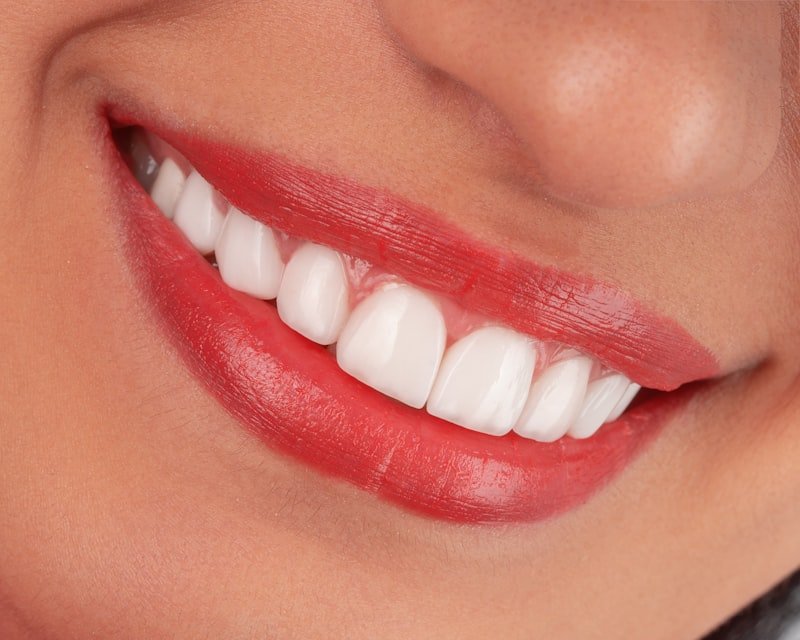
Turkey teeth vs veneers: the key difference
The key difference is how much of your own tooth is removed. A crown covers the entire visible tooth, so it has to be reduced on all sides. A porcelain veneer covers mainly the front surface and part of the biting edge, so preparation is usually limited to a thin layer of enamel, and in some cases very little or none. Composite bonding adds tooth-coloured resin and often needs no preparation at all.
The nickname "Turkey teeth" became widely known through images of very white, uniform smiles, many of which were full sets of crowns on teeth that had been healthy. That is why the comparison matters. It is not really "Turkey vs elsewhere"; it is "crowns vs veneers vs bonding", and which one your teeth actually need. For background on the term itself, see what are Turkey teeth; for a material-by-material comparison, see veneers vs crowns. This article focuses on how to make the decision and how to check what is in your plan.
Three treatments side by side
| Full crowns | Porcelain veneers | Composite bonding | |
|---|---|---|---|
| What covers the tooth | The whole tooth, all sides | The front and edge | Resin added where needed |
| Enamel removed | A lot, all round | Usually a thin layer at the front | Little or none |
| Reversible? | No | Generally no, once enamel is removed | Often largely, if no preparation was done |
| Typically suited to | Broken, heavily filled or root-treated teeth | Colour, shape, small gaps and chips on sound teeth | Small chips, gaps, edge repairs |
| Visits in Istanbul | Several over about a week | Several over about a week | Often one session per tooth |
| Upkeep | Replacement after years, more tooth lost each time | Replacement after years, often less tooth lost | Polishing and repairs every few years |
None of these is automatically "better". A crown is the right answer for a broken molar. A veneer is often the right answer for a discoloured front tooth that is otherwise healthy. Bonding can be the right answer for a single chipped edge. Problems arise when the most invasive option is used where a lighter one would have done.
How to tell which treatment you are being offered
You can usually tell from four things: the name on the plan, the number of teeth, the description of preparation and the material listed.
- The name. Look for the words "crown", "veneer" or "laminate", or "bonding" or "composite". Plans written in Turkish may say kron or zirkonyum kron for crowns and lamina or yaprak porselen for veneers. Vague phrases such as "smile package" or "full set" are not enough on their own.
- The number of teeth. A smile usually shows 8 to 10 upper teeth, sometimes more. Plans for 20 or more units on teeth that are not damaged deserve a careful second look and a clear explanation.
- The preparation. Ask how much enamel will be removed from each tooth, and whether any teeth will be prepared for crowns.
- The material. Zirconia is used mainly for crowns. E.max can be a crown or a veneer, so the material alone does not tell you which; the name and the preparation do.
Photos of other smiles are not a reliable guide. A row of crowns and a row of veneers can look almost the same from the front.
Reading a dental treatment plan, line by line
A clear written plan lists each tooth separately, with the treatment, the material and the cost, and it should make sense to you before you agree. Dentists number teeth using a two-digit system: the first digit is the quarter of the mouth (1 upper right, 2 upper left, 3 lower left, 4 lower right, from your point of view), and the second is the tooth, counting from the front. So 11 and 21 are the two upper front teeth, and 16 is the first upper right molar.
When you read the plan, check that:
- every tooth is listed by number, not just a total such as "20 units";
- each line says whether it is a crown, veneer, bonding, filling or something else;
- preliminary work is listed: cleaning, treatment of gum disease, fillings or root canal treatment, if needed;
- the material is named for each restoration;
- the number of appointments and days is stated;
- the total cost is shown in writing, with the currency.
If a tooth is listed for a crown, it is reasonable to ask why that tooth could not have a veneer or bonding instead. A careful dentist will have a reason, such as a large old filling, a crack or a previous root canal treatment, and will show it to you on the X-ray or in a photo.
A decision checklist before you agree
Work through these points with your dentist. If you cannot answer one of them, ask before treatment starts.
- What is the problem I want to fix? Colour, shape, gaps, chips, crowding, missing teeth or worn teeth each point to different treatments.
- Are my teeth and gums healthy? Decay and gum disease should be treated first.
- Could whitening, bonding or orthodontics do part of the job? Many colour problems respond to whitening, and many crowding problems to clear aligners, without removing enamel.
- How many teeth really need treatment? Treating fewer teeth well is often better than treating many.
- Which teeth will be crowned, and why?
- Have I seen a mock-up? A trial of the planned shape in temporary material lets you judge length, width and shade before anything is permanent.
- What shade suits my face and skin? Very bright shades can look artificial, especially next to natural lower teeth.
- Is my bite part of the plan? Grinding and bite problems affect what material and design are chosen.
- Is the timeline realistic? Rushed work leaves no room for adjustments.
Questions to ask your dentist
These questions are simple, and a careful dentist will be glad to answer them:
- "Are these crowns or veneers, tooth by tooth?"
- "How much of each tooth will you remove?"
- "Is any of this treatment reversible?"
- "Can you show me why this tooth needs a crown rather than a veneer?"
- "Do I have any gum disease or decay that needs treating first?"
- "Will I see a mock-up before you prepare any teeth?"
- "What happens if I am not happy with the shape or shade at the try-in?"
- "How long do restorations like these usually last, and what will replacing them involve?"
- "Will I get copies of my X-rays and plan to take home?"
The answers matter, but so does the way they are given. You should not feel hurried, and you should be able to take the written plan away and think about it, or show it to another dentist.
When crowns really are the right choice
Crowns are the right choice when a tooth needs to be held together or rebuilt. Typical reasons include a large filling that leaves little natural tooth, a cracked tooth, a tooth that has had root canal treatment (especially a back tooth), heavy wear from grinding, and a tooth that is too broken down for a veneer to bond to reliably. Crowns are also used on implants and as part of bridges.
In a mixed case, the plan may sensibly include crowns on some teeth and veneers or bonding on others. That is normal. What matters is that each choice has a clear reason linked to that tooth. Our zirconia crowns and veneers pages explain each treatment in more detail.
How we approach the choice
At Beyaz Gülüş, the treatment is decided after an examination and any X-rays needed, and the written plan lists each tooth with its treatment. You can start by sending photos of your smile, front and side, and any recent X-rays on WhatsApp. A dentist reviews them and replies with a preliminary plan and the expected number of days, which is confirmed or adjusted once your teeth are examined in person.
Crown and veneer cases are planned by dentists including Dt. Kadri Söylemez (smile design and implants) and Dt. Osman Cemal Binan (prosthetic dentistry). If you want to compare costs, our price list shows the ranges for each treatment.
Frequently asked questions
Are Turkey teeth crowns or veneers?
Are veneers better than Turkey teeth?
How can I tell if I have crowns or veneers?
Do veneers require shaving the teeth?
Can Turkey teeth be changed to veneers later?
What should a dental treatment plan include?
How many veneers do I need for a full smile?
This page gives general information and is not a substitute for an examination. Whether a treatment is suitable for you, and how long it takes, is decided after your dentist has examined you and reviewed your X-rays.