
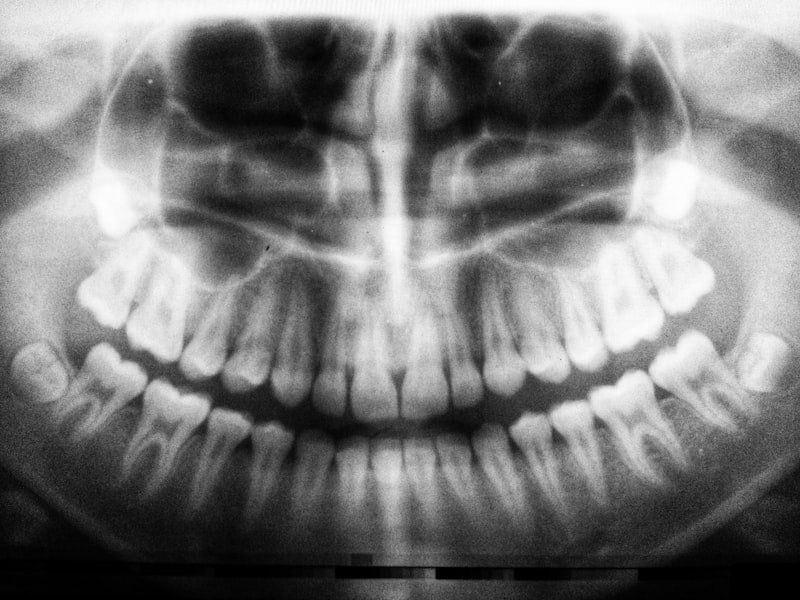
- Anaesthesia
- Local anaesthetic
- Typical procedure time
- From about 20 minutes to an hour
- Stitches
- Dissolving or removed after about 7–10 days
- Soft-tissue healing
- Usually 1–2 weeks
- Assessment
- Free examination and X-ray
What does oral surgery cover at a dental clinic?
In a dental clinic, oral surgery means minor surgical procedures inside the mouth that go beyond a routine filling or a simple extraction. Typical examples are listed below; at your examination the dentist explains which of them can be done at the clinic in your case and which are better referred to a hospital:
- surgical extractions of broken-down teeth, teeth with curved or fused roots, and retained root fragments;
- impacted teeth, most often wisdom teeth, but also canines or premolars trapped in the bone;
- pre-implant procedures such as bone grafting, ridge preservation after an extraction and sinus lifts;
- implant placement itself, described on our dental implants page;
- root-end surgery (apicectomy), where infection persists at the tip of a root-filled tooth and retreatment is not possible;
- removal of small soft-tissue lumps or minor cysts where the diagnosis is clear.
Simple versus surgical tooth extraction in Istanbul
A simple extraction is used when a tooth is fully visible and can be loosened and lifted out with instruments. A surgical extraction is needed when that is not possible: the tooth has broken at the gum line, the roots are curved or hooked, the tooth is ankylosed (fused to the bone), or it has not erupted at all.
In a surgical extraction, the gum is opened with a small incision, a little bone may be removed, and the tooth is often divided into sections so each piece comes out with minimal force on the surrounding bone. The site is then cleaned and stitched. Taking a tooth out in pieces sounds dramatic, but it is usually gentler on the jaw than forcing it out whole.
Wherever an implant may follow, we try to preserve as much bone as possible during the extraction. In some cases graft material is placed straight into the socket to limit shrinkage.
How a surgical procedure is organised
- Send your X-rays: Share any recent X-rays and a short medical history on WhatsApp so we can see whether your case suits a dental clinic.
- Examination: Free examination and X-ray in Istanbul; a 3D scan is arranged only when the anatomy needs it. You receive a written plan and cost.
- Surgery: Carried out under local anaesthetic, early in your stay. You go home the same day with written aftercare instructions.
- Check-up: A review two to three days later to check healing and swelling.
- Stitches and onward plan: Stitches dissolve or are removed after about a week; any implant or prosthetic stage is scheduled from there.
Impacted teeth beyond the wisdom teeth
Wisdom teeth are the most commonly impacted, and they have their own page. Upper canines are the second most common. An impacted canine is not always removed: in younger patients it can often be surgically exposed and then guided into place with braces, which keeps a tooth that matters both for appearance and for the bite. That calls for close coordination with orthodontic treatment, which is a long-term plan rather than a single trip.
In adults, an impacted tooth that causes no harm may simply be monitored on X-ray. Removal is considered when it damages the roots of neighbouring teeth, forms a cyst or gets in the way of implant or orthodontic plans.
Preparing the jaw for implants
Bone shrinks after teeth are lost, and sometimes there is not enough of it in the right place for an implant. Pre-implant surgery rebuilds it:
- Socket preservation: graft material placed into a fresh extraction socket to reduce shrinkage.
- Ridge augmentation: rebuilding a narrow or low ridge with graft material and a protective membrane.
- Sinus lift: gaining height in the upper back jaw by raising the sinus floor.
Small grafts are often done at the same time as the implant. Larger ones need months to mature first, which changes the travel plan. A graft is a living process, so smoking and poor blood-sugar control affect it in the same way they affect implants.
What we refer to a hospital, and why
Not every procedure that involves the mouth belongs in a dental clinic. We do not treat, and will refer you to a hospital oral and maxillofacial surgery department for:
- lesions that look suspicious, where a biopsy and full investigation are needed;
- large cysts or growths in the jaw;
- jaw fractures and facial trauma;
- corrective jaw (orthognathic) surgery;
- procedures that need general anaesthetic or hospital monitoring;
- patients whose medical conditions make clinic surgery unsafe.
If we see something on your X-ray or in your mouth that needs investigating, we tell you plainly and give you the findings to take to a specialist, at home or in Istanbul. We would rather lose a treatment than push one that is not ours to do.
Healing after oral surgery
How quickly you recover depends mostly on how much bone was involved. A typical pattern after a surgical extraction looks like this:
| Time after surgery | What is normal |
|---|---|
| First 24 hours | Oozing of blood, numbness wearing off, swelling starting |
| Days 2–3 | Swelling and stiffness at their peak, then easing |
| Days 4–7 | Most discomfort fading; bruising may turn yellow |
| Days 7–10 | Stitches dissolve or are removed; gum largely closed |
| Weeks to months | Bone gradually fills the socket underneath |
Pain that gets worse rather than better after day three, a bad taste, fever or swelling that keeps increasing are reasons to contact us straight away.
Medicines and health conditions to tell us about
Before any surgery, please tell us about all medicines and supplements you take. The ones that matter most are:
- blood thinners (warfarin and newer anticoagulants, antiplatelet drugs): do not stop them yourself, as your own doctor must advise;
- bisphosphonates and other bone medicines, past or present, because of a rare jaw-healing complication after surgery;
- diabetes treatment and recent control;
- steroids or immune-suppressing drugs;
- any history of heart valve problems, radiotherapy to the head or neck, or bleeding disorders.
A letter or recent results from your doctor make planning safer and avoid delays once you arrive.
Planning your trip around dental surgery in Turkey
Surgery should happen early in your stay, not the day before your flight. That leaves time for a check-up two or three days later and, where needed, for stitches to be checked. As a rough guide:
- after a simple extraction most people can fly within a day or two;
- after surgical extractions or grafting, allow a few days and a check-up first;
- after a sinus lift, you may be asked to wait longer, as cabin pressure changes affect the sinus.
Our guide to flying after dental treatment goes into more detail.
Who carries out oral surgery here?
Surgical cases are handled by our dentists with surgical backgrounds. Dt. Yusuf Yuca holds a PhD in oral and maxillofacial surgery and works on surgery and implants. Dt. Cemal Özdemir has 25 years of experience, including surgery and implants. You can ask at the examination who will carry out your procedure.
Frequently asked questions
What is the difference between a dentist and an oral surgeon?
Is tooth extraction in Istanbul done under local anaesthetic?
How long does a surgical extraction take?
How soon can I fly after oral surgery?
Will I need antibiotics?
Can you remove a cyst or take a biopsy?
Is it sensible to have dental surgery in Turkey as a visitor?
What does the cost of oral surgery depend on?
This page gives general information and is not a substitute for an examination. Whether a treatment is suitable for you, and how long it takes, is decided after your dentist has examined you and reviewed your X-rays.